
Employer support for better CPP / QPP claiming decisions
By: Paul Rossi, and Janice Holman, CFA, CFP
Most working Canadians, aged 18 and over, are required to contribute to the Canada Pension Plan (CPP) or Québec Pension Plan (QPP) when annual income exceeds $3,500. Both employees and employers contribute 5.95% (6.3% QPP) of pensionable earnings up to the year’s maximum pensionable earning (YMPE) – $74,600 in 2026 – and 4% between the YMPE and year’s additional maximum pensionable earning ($85,000 in 2026). Benefits can begin as early as age 60 and as late as age 70 for CPP, or age 72 for QPP, with the amount received depending on contributions, earnings history and claiming age. Beginning payments between 60 and 65 results in a permanent reduction of 7.2% per year, beginning payments between 66 to 70 (72 for QPP) results in a permanent increase of 8.4% per year.
For many Canadians, the CPP or QPP will be one of their most valuable retirement assets providing secure, inflation-indexed income for life. However, many don’t understand how significant the decision on when to claim these benefits is to their overall retirement security.
This is not just an individual issue. For employers, helping employees better understand when and how to claim this benefit, can support stronger retirement readiness, smoother workforce transitions and better outcomes from the retirement programs they already offer.
Why are so many Canadians claiming early?
Research from the National Institute on Ageing (NIA) suggests that early claiming is the norm. Approximately 90% of Canadians start CPP or QPP benefits by age 65 and many make the decision with limited advice or analysis. According to their research, only 1 in 7 recipients report putting significant effort into the decision of when to claim CPP and nearly 40% did not consult anyone during the decision-making.
Three common strategies that are driving early claim decisions.
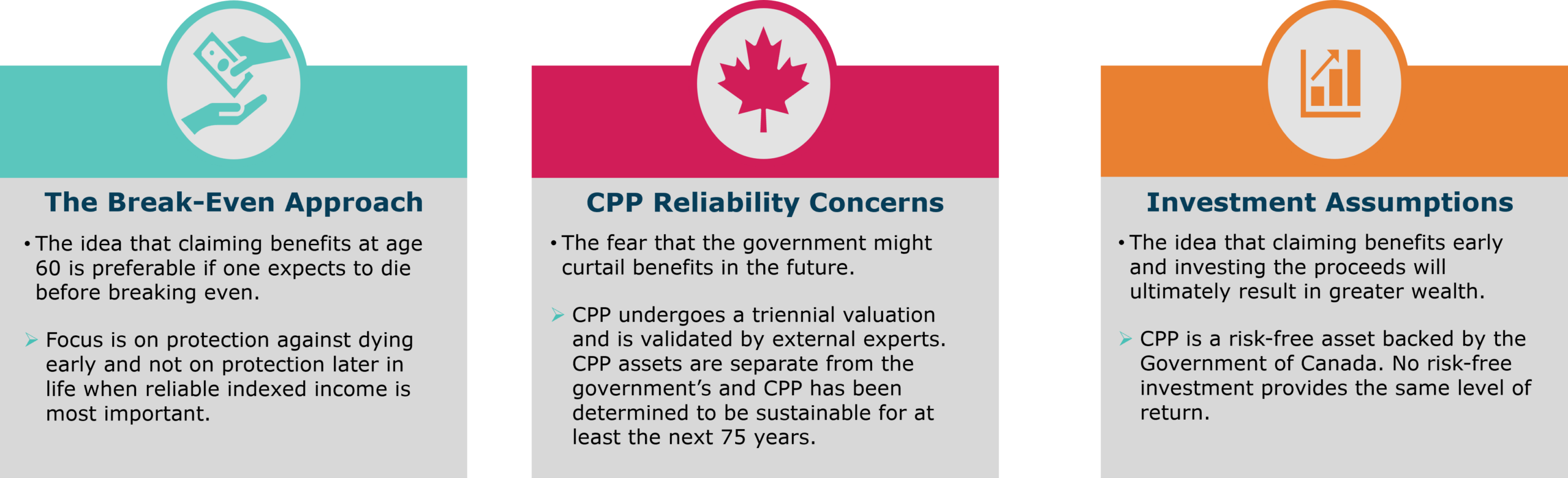
At first glance these strategies appear reasonable. However, they often lead employees to focus on the wrong risk. A break-even calculation may overemphasize the possibility of dying early and understate the financial impact of living a long life. Similarly, the “take it and invest it” argument often assumes investment returns without fully reflecting the market risk required to achieve them or the value of CPP’s inflation protection and lifetime guarantee.
Employees may also worry about the long-term sustainability of CPP. Evidence-based education can help address these concerns by explaining that CPP / QPP is subject to regular actuarial review, is separately funded from government operating accounts and has been tested to ensure it remains sustainable for the next 75 years.
The value of delaying CPP and QPP
Delaying benefits is not right for everyone, but the potential value can be significant. A person who delays their benefit from age 60 to age 70 can receive more than twice the monthly pension they would have received at age 60. This higher amount is payable for life and increases with inflation.
Research by Eckler’s Resident Scholar Dr. Bonnie-Jeanne MacDonald shows that an individual with median CPP income and average life expectancy could receive more than $100,000 of additional secure lifetime income, in today’s dollars, by delaying benefits from age 60 to age 70. For females, who have longer life expectancy, this number is even higher. For many employees, few other retirement decisions offer this level of potential improvement in guaranteed income.
For employers, the value is indirect but also important. Employees with stronger secure income may have more confidence about retirement timing, less anxiety about leaving the workforce and a clearer understanding of how their workplace plan fits into the broader retirement picture.
Reframing the role of CPP and QPP
Both plans are contributory, earnings-based programs that provide guaranteed lifetime income indexed to inflation. This makes CPP and QPP different from most personal savings: they are not simply retirement assets, but a source of predictable income that continues no matter how long a retiree lives.
That distinction matters for employers too. Workplace retirement programs often focus on account balances, contribution rates and investment returns. These are important, but they do not tell the full retirement readiness story. Employees also need to understand how guaranteed income sources can help cover essential expenses, reduce exposure to market volatility and protect against the risk of outliving savings.
Secure, inflation-indexed income plays a fundamentally different role than invested assets. While savings can help fund discretionary spending, a strong income foundation can provide confidence that essential expenses will be covered regardless of market conditions, inflation or longevity.
The newly released NIA Retirement Income Framework provides a more practical way to look at income sources. The income “foundation” includes secure, lifelong sources such as CPP/QPP, Old Age Security, workplace defined benefit pensions and annuities. The foundation can provide lifelong monthly income for routine spending. “Spending buckets” include Registered Retirement Savings Plans, Registered Retirement Income Plans, Tax-free Savings Accounts, home equity and other savings. Spending buckets can provide flexible financial resources for non-routine spending. Helping employees see how these pieces work together can make retirement planning more tangible and support more informed claiming decisions.
Plan sponsor support: A high-impact, cost-effective retirement readiness initiative
Plan sponsors do not need to become personal financial advisers. And, unlike increasing pension benefits or matching contributions, improving CPP/QPP education does not require additional plan funding.
Plan sponsors can play a key role by reframing retirement income communications, educating members on secure income, countering harmful narratives, and providing tools and training. Broader financial wellness communication, targeted education sessions, access to personalized on-line retirement planning platforms and individual retirement income modelling can help employees better understand the impact of different claiming ages and how to bridge income needs if delaying benefits is appropriate. Seeking third-party expertise in financial planning, retirement modelling and communication can help improve outcomes for employees and increase the return on investment for plan sponsors.
Whether plan sponsors choose to undertake support initiatives themselves or partner with a third-party, support must be unbiased. The goal is not to encourage every employee to delay. Earlier claiming may make sense for employees with shorter life expectancy, immediate cash flow needs, high-interest debt or other personal circumstances. The objective is to help employees understand the trade-offs so they can make an informed decision about something that will have lifelong consequences.
As an employer you can play a significant role in providing the information and tools that give employees the knowledge and confidence they need to ask more-informed questions and seek expert advice where appropriate. Plan sponsors can improve retirement outcomes, support greater financial confidence and more successful transitions from work to retirement — without increasing plan costs.
This issue of Investment Brief has been prepared for general information purposes only and does not constitute professional advice. Should you require professional advice based on the contents of this notice, please contact an Eckler consultant.