
Quantitative investing: A complementary approach for more resilient equity portfolios
By: Devin Forbes and Nathan Hayes
Investment Brief – November 2026
Plan sponsors are being asked to generate returns in equity markets that are increasingly concentrated, fast-moving and costly to navigate while maintaining clear oversight of risk, fees and manager performance. Against this backdrop, quantitative investing is gaining renewed attention as a scalable and transparent source of active equity exposure. Rather than replacing fundamental management, it can offer plan sponsors a complementary way to diversify investment processes, manage factor risks and strengthen the resilience of the overall portfolio. This article examines how quant strategies have evolved, why institutional interest is returning and what committees should consider when evaluating their role in a plan’s equity allocation.
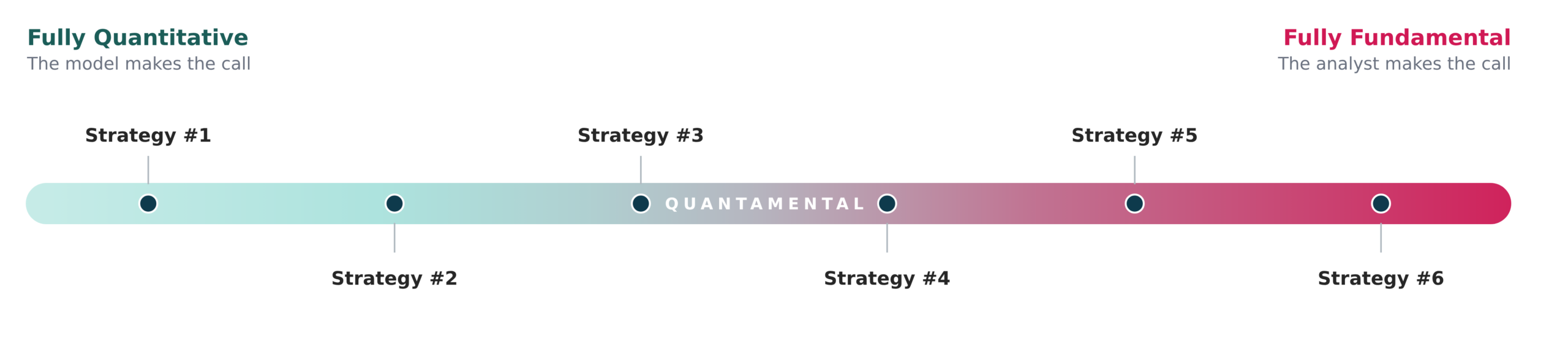
Presented as part of a spectrum rather than as a strict alternative to fundamental investing, at the fully quant end, a model drives buy and sell decisions by scoring a broad universe of stocks on measurable characteristics and holding the highest-ranked names. Its potential edge comes from applying consistent rules across hundreds of positions —breadth over depth. At the fully fundamental end, analysts investigate a smaller set of businesses and back their highest-conviction ideas to gain an informational or judgment-based edge — depth over breadth. Between these endpoints are “quantamental” approaches that combine systematic tools with fundamental research.
Quant managers typically build portfolios around factors: measurable stock characteristics, such as value, momentum, quality, and low volatility, that help explain differences in returns across different stocks. Historically, some factors have delivered excess returns, while others have reduced volatility, and combining them has improved risk-adjusted outcomes.
Quant managers typically target factor exposures explicitly through systematic signals, while fundamental managers may accumulate factor exposures indirectly through security selection. This article explains why understanding these exposures are essential when determining the role a quant manager should play within an overall equity portfolio.
The evolution
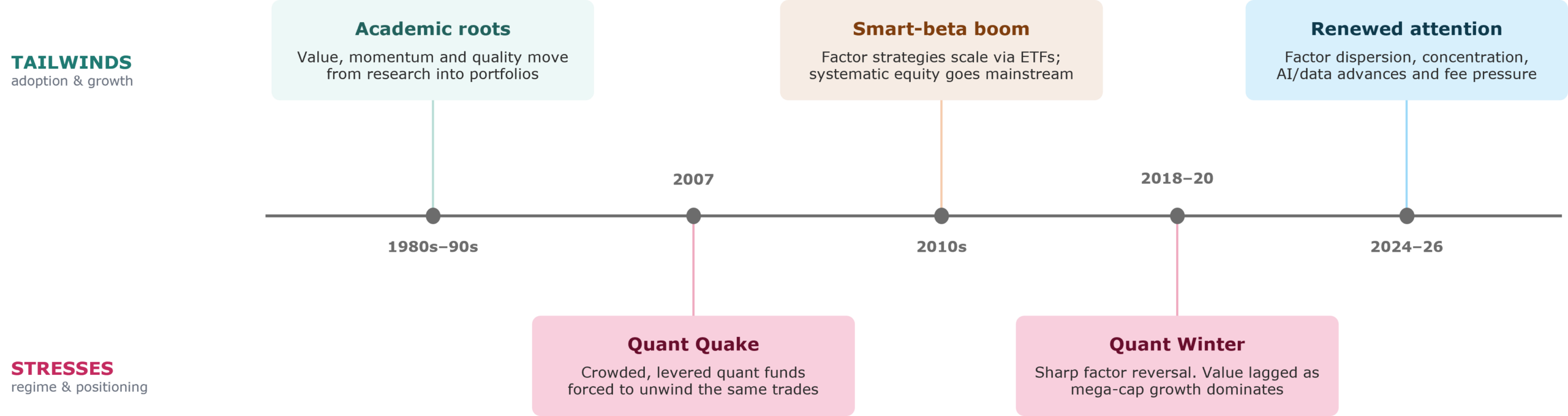
In the 1980s and ‘90s, academic research on factors such as value, size and momentum began making its way into institutional portfolios. By the 2010s, smart-beta products and exchange-traded funds had brought systematic investing into the mainstream. The path was not always smooth, however. In August 2007, several large multi-strategy hedge funds, likely to face losses in credit markets, sold their quantitative equity positions to raise cash. Because many quant funds held similar, leveraged long-short portfolios, the selling pushed prices against all of them and forced further deleveraging, which produced steep losses over a few days before prices largely recovered. The 2018–2020 “Quant Winter” coincided with a sharp shift in market leadership, as value struggled and mega-cap growth stocks surged. Neither episode indicated that long-only quant investing was fundamentally broken. The first exposed the risks of leverage and crowding, and the second reflected a prolonged but cyclical factor drawdown.
For long-only institutional investors, the principal considerations are factor exposure, turnover, transaction costs, capacity and portfolio fit, rather than the risk of forced deleveraging. Interest in these strategies has renewed in recent years, driven by greater factor dispersion, rising benchmark concentration, fee pressure and advances in artificial intelligence and data.
Performance evidence and renewed interest
The annual performance table below compares the median of the Eckler Quantitative Global Equity Universe with the MSCI All Country World Index and MSCI factor indexes. Returns are gross of fees and stated in Canadian dollars.
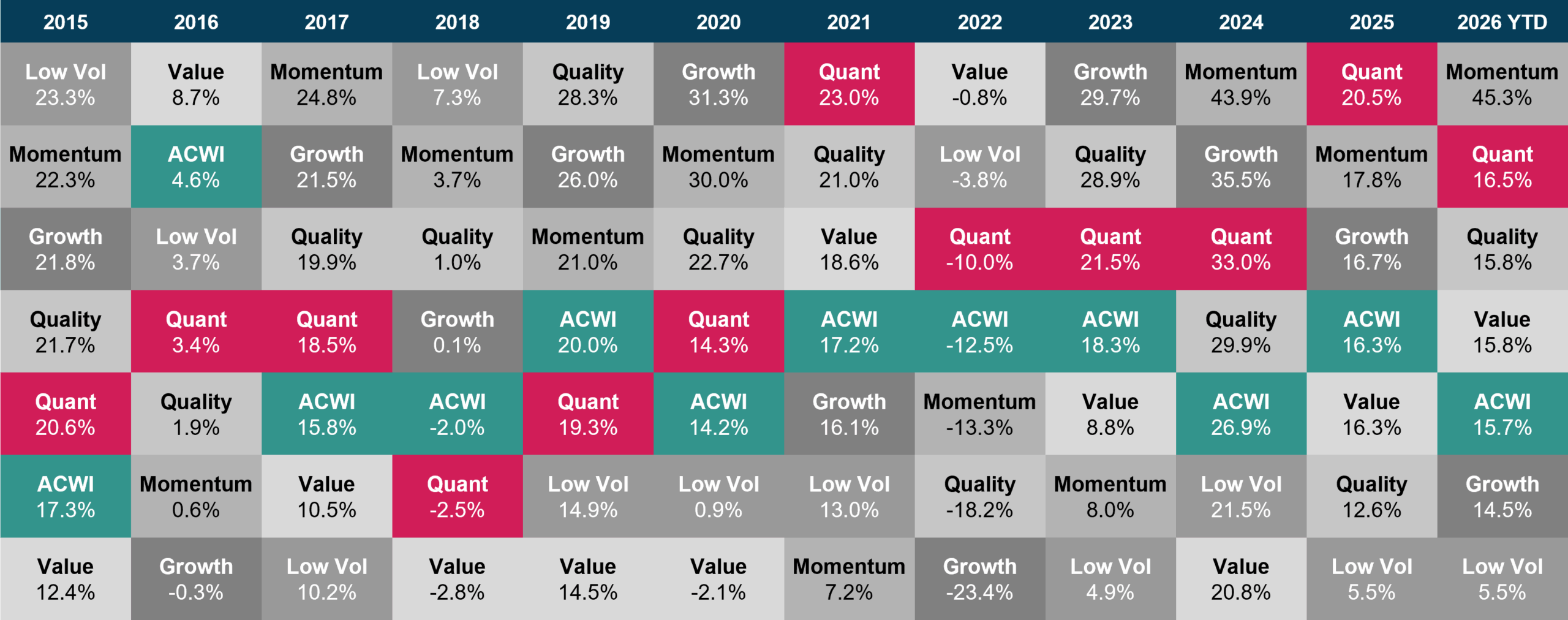
Note: All returns are gross of fees and stated in CAD. Factor returns are represented by the MSCI Factor Indices. Quant returns represented by the Eckler Quantitative Global Equity Universe median.
The key message from this table is not that quant strategies win every year, but that a diversified multi-factor process does not consistently track any single factor. Because most managers blend several signals, there is limited reliance on any one factor which helps reduce relative return volatility as market leadership shifts.
Six developments are identified as drivers of renewed institutional interest:
- Market concentration: As of June 30, the top 10 U.S. stocks represent 36% of the S&P 500’s market capitalization, compared with roughly 25% at the dot-com peak. Mega-cap technology and artificial-intelligence leadership can make benchmark-relative fundamental investing more difficult.
- Greater dispersion: The gap between the best- and worst-performing stocks has widened, giving security selection and factor signals more opportunity. Broad diversification and position limits also reduce the impact of extreme moves in any single stock.
- Clearer transparency: Quant performance can be attributed directly to the model’s factors and signals. Fundamental attribution is generally limited to sector, country and security effects which map less directly to the manager’s decision process.
- Beyond simple factor replication: Modern quant investing diversifies across signals, data and investment horizons.
- Data and artificial intelligence: Many quant strategies have used alternative data and artificial intelligence for a decade or more. Recent advances, particularly in applying language models to unstructured data, favour managers with established data and research infrastructure.
- Greater scalability: Quant strategies may be more scalable because their costs are driven mainly by data and computing rather than by larger teams of analysts and portfolio managers.
Fees are another important consideration. For a $50 million global equity allocation, the median fees are 46 basis points for a quant strategy, compared to a median fee of 62 basis points for a fundamental strategy. Beyond the benefits of recent quant performance, institutions are looking for scalable, transparent, lower-cost and diversifying sources of active return.
Active risk, strategy structures and implementation
Active risk is framed through tracking error, or the degree to which a manager’s performance differs from its benchmark. The indicative ranges are: less than 0.5% for passive indexing; 1%–2% for enhanced indexing; 2%–4% for long-only quant equity; 3%–5% for quant extension strategies; and 4%–8% for high-active-share fundamental equity. Most long-only quant strategies therefore occupy a middle ground: more active than enhanced indexing, but generally less concentrated than high-active-share fundamental management.
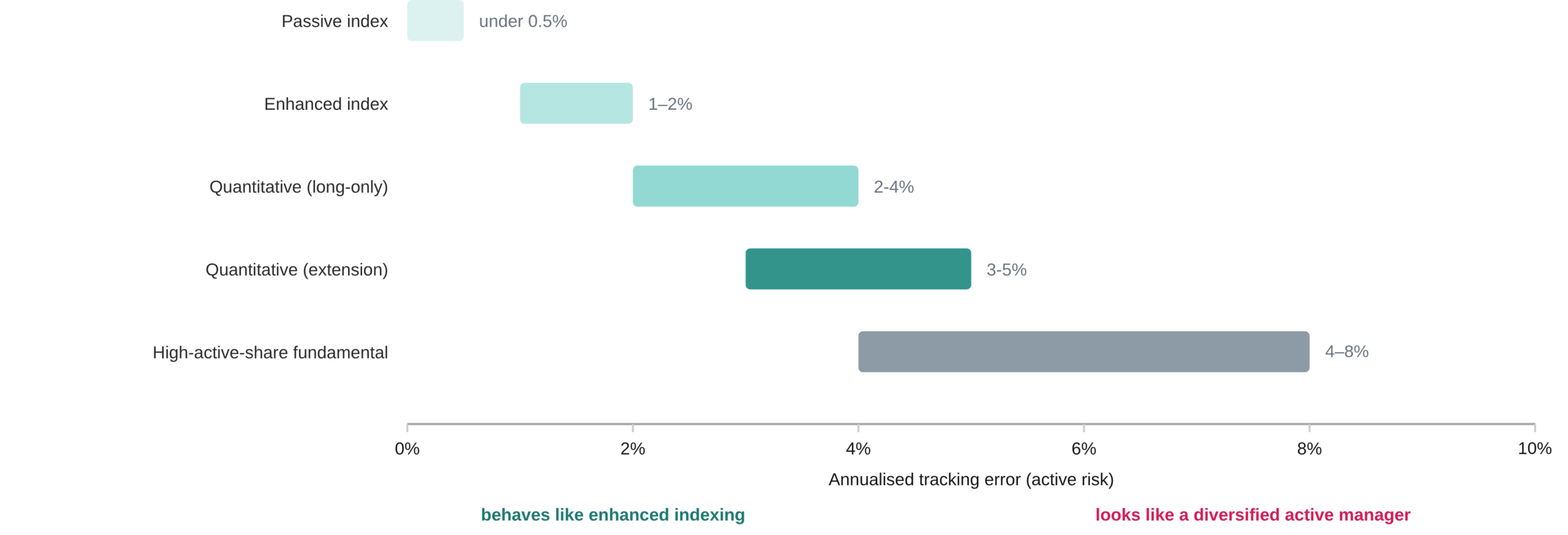
Quant investing does not necessarily imply low risk, however. Active risk depends on the number of holdings, factor concentration, sector, country and industry constraints, and relative position sizes. A low-tracking-error quant strategy may behave like enhanced indexing; a higher-tracking-error strategy may look more like a diversified active manager. The ranges are indicative and are not intended as a recommendation for quant over fundamental management. The two approaches are different and often complementary.
Quant strategies can take several forms. Long-only equity strategies own stocks expected to outperform and are generally benchmark-aware. Enhanced index strategies use modest active risk to seek incremental returns above a benchmark and can serve as low-cost core exposure. A 130/30 or similar extension strategy uses short positions to fund additional long exposure.
Trading horizons also vary. High-frequency or intraday approaches focus on trading and execution and are generally less relevant in institutional portfolios. Medium-term factor and stock-selection strategies hold positions for months or longer and can still have relatively high turnover. Longer-term systematic fundamental approaches use multi-year signals based on profitability, valuation, balance-sheet strength, capital allocation and earnings quality. Most long-only institutional applications are described as lying between medium-term and longer-term horizons.
A five-part framework for evaluation, governance and monitoring
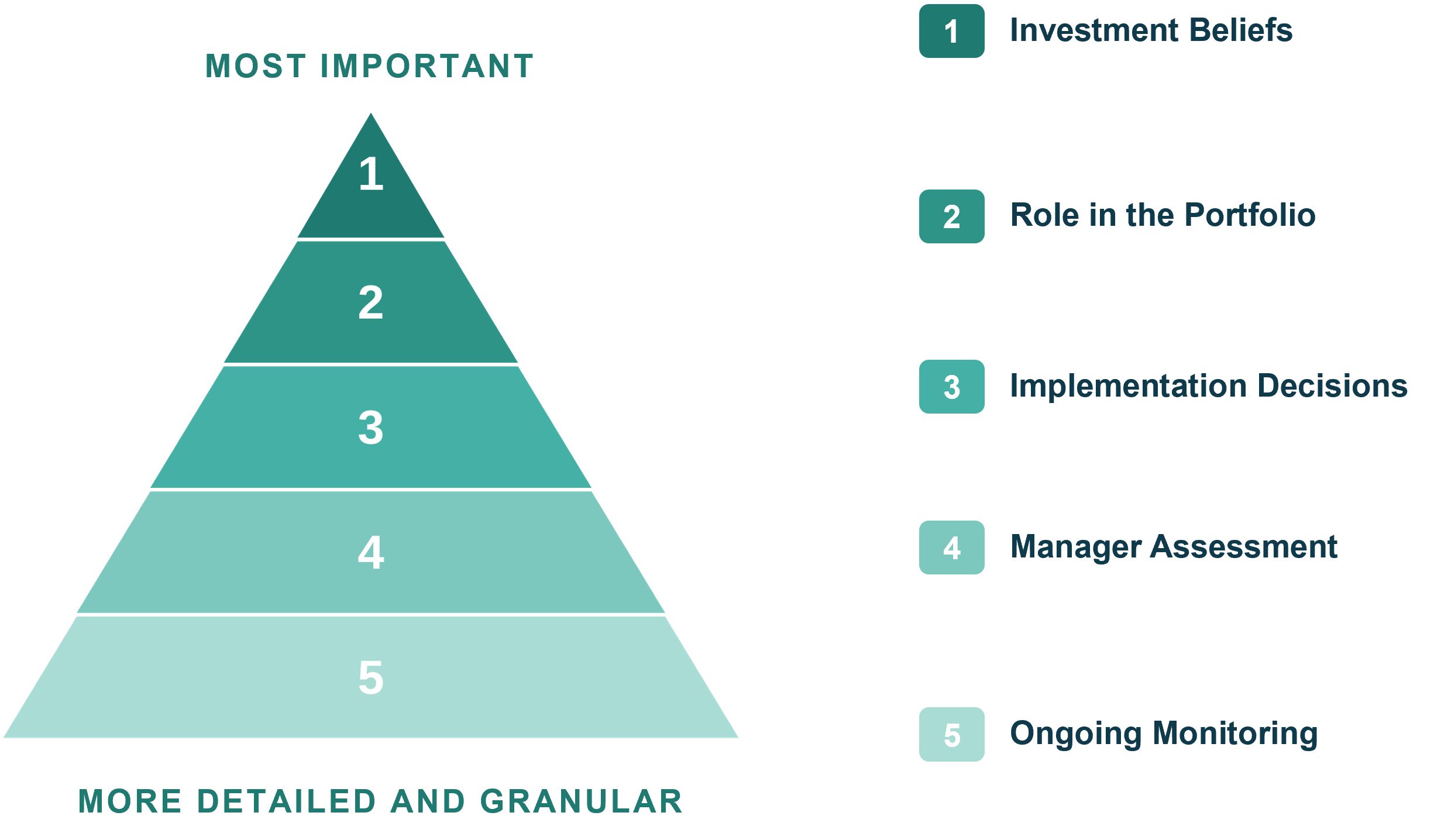
A structured approach to evaluation, governance and monitoring helps plan sponsors look beyond recent performance and assess whether a strategy’s role, risks, costs and investment process align with the plan’s objectives. It also gives committees a consistent basis for selecting managers, overseeing implementation and monitoring the mandate over time.
- Confirm investment beliefs: Determine whether systematic stock selection can add value after fees and costs, and whether its benchmark-oriented approach fits the plan’s philosophy.
- Define the portfolio’s role: Decide whether the strategy will serve as a core allocation, complement fundamental managers or replace passive exposure and identify what diversification it adds.
- Set implementation parameters: Define tracking error, factor tilts, regional exposure and market-cap ranges to limit unintended risks and support the total equity portfolio.
- Assess the manager: Look for differentiated signals, strong investment and technology expertise, institutional-quality systems and disciplined capacity management.
- Monitor over time: Compare results with stated objectives over a full market cycle and confirm that the process, team, factor exposures and portfolio fit remain consistent.
For plan sponsors, the decision is not whether quantitative investing is inherently better than fundamental management but whether it can strengthen the overall equity portfolio. When its role is clearly defined and supported by disciplined manager selection and ongoing oversight, a quant strategy can provide differentiated sources of return, broader diversification, greater transparency and potentially lower costs.
We bring these perspectives and understanding to all of the work that we do for our clients at Eckler. If you would like to talk more about how our experience and expertise might help drive better outcomes for your organization and your plan members, reach out to Devin Forbes and
Nathan Hayes.
This issue of Investment Brief has been prepared for general information purposes only and does not constitute professional advice. Should you require professional advice based on the contents of this notice,
please contact an Eckler consultant.