
From financial knowledge to action
Capital Accumulation Plan Income Tracker (CAPit) – October 2026
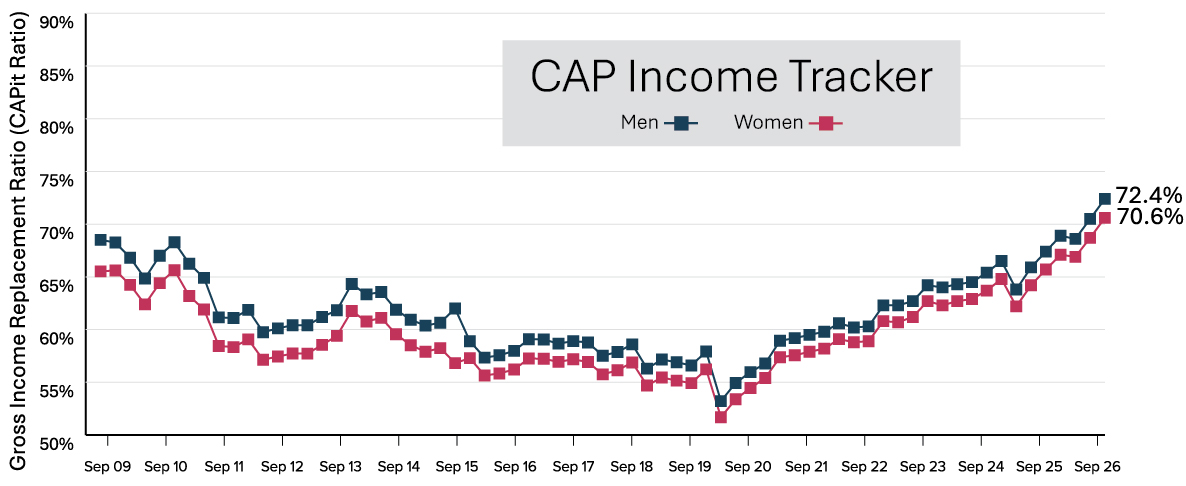
Markets remained resilient in the third quarter of 2026 as strong corporate earnings and continued AI‑related investment helped offset the impact of rising energy prices, higher interest rates, and geopolitical uncertainty. Against this backdrop, Capital Accumulation Plan (CAP) member outcomes reached record levels. A male member retiring at the end of September 2026 achieved a gross income replacement ratio of 72.4%, while a female member achieved 70.6%, representing the strongest retirement outcomes observed in CAPit’s history.
Financial education plays an important role in helping employees make informed decisions about their money. However, understanding financial concepts is only the first step. The bigger challenge is turning that knowledge into actions that can improve financial wellness today and support better retirement outcomes in the future.
Recent feedback from participants in Eckler’s financial education workshops highlight this challenge. More than 40% described their understanding of general financial concepts as ranging from basic to feeling lost. Financial security was also a concern, with 20% reporting little to no confidence that they could find $2,000 to cover a financial emergency. These pressures can make longer-term retirement savings decisions more difficult.
The encouraging finding is that education can make a difference. Following the workshops, financial-knowledge scores improved by 22%, while the number of participants reporting high or overwhelming levels of financial stress fell by 40%. More than three-quarters also reported feeling empowered to change their financial situation.
However, education alone is not enough to create lasting change. Members also need opportunities to apply what they have learned to their own circumstances. Retirement projections, savings and budgeting tools, access to professional financial guidance, and flexible workplace savings programs can help translate general financial knowledge into personal and actionable decisions.
Ongoing support is important too. Financial priorities evolve as members move through different life stages, and unexpected events can quickly change even a well-established plan. Regular communication, educational touchpoints and tools that members can revisit help reinforce good financial habits and provide opportunities to adjust along the way.
Financial literacy is most valuable when members can put it into practice. Combining education with practical tools, personalized support and ongoing engagement can help members move from simply understanding their money to taking actions that improve their financial wellness and support stronger long-term retirement outcomes.
About the CAP Income Tracker
The CAP Income Tracker assumes the member made annual contributions at a rate of 10% starting at age 40, will receive maximum Old Age Security and Canada/ Quebec Pension Plan payments, and will use their CAP account balance at retirement to buy an annuity. The member’s CAP account is invested based on a balanced strategy. Salary has been adjusted annually in line with changes in the average industrial wage and is set at $78,954 as of September 30, 2026.
This issue of CAPit has been prepared for general information purposes only and does not constitute professional advice. Should you require professional advice based on the contents of this publication, please contact an Eckler consultant.