
Turning your Capital Accumulation Plan savings into a retirement income
Capital Accumulation Plan Income Tracker (CAPit) – April 2026
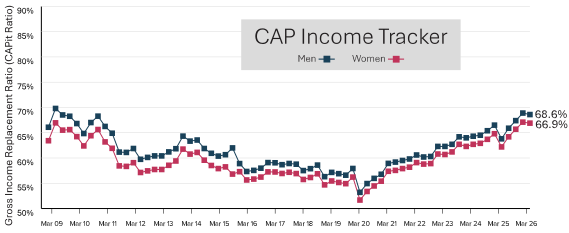
Markets were more volatile in the first quarter of 2026 as the U.S., Israel and Iran miliary conflict disrupted global energy supply, drove a sharp increase in oil prices, and renewed inflation concerns. Against this backdrop, Capital Accumulation Plan (CAP) member outcomes edged slightly lower. A male member retiring at end of March 2026 achieved a gross income replacement ratio of 68.6%, down marginally from 68.9% in December 2025. A female member achieved 66.9%, down from 67.1%.
For many members, the transition from saving to spending is one of the most complex and consequential phases of retirement. While accumulation often benefits from default options and automation, decumulation requires members to make active, and sometimes irreversible, decisions about how their savings will generate income. These choices are further complicated by the need to coordinate workplace savings with government benefits like the Canada / Quebec Pension Plan (C/QPP).
For members retiring from a CAP, there are typically three primary ways to convert savings into income: Life Income Funds (LIFs), Registered Retirement Income Funds (RRIFs), and annuities.
Each option offers a different balance of flexibility, income stability, and longevity protection. LIFs and RRIFs allow members to retain control over their capital and adjust withdrawals over time but expose retirement income to market volatility and the risk of outliving savings. Annuities provide guaranteed lifetime income which helps to mitigate longevity risk but require members to give up access to capital and flexibility.
The timing of CPP also plays a critical role in shaping these decisions. Delaying CPP beyond age 65 increases monthly payments and provides valuable inflation‑protected guaranteed income later in retirement. For some members, using LIF or RRIF withdrawals to bridge income needs in early retirement can allow CPP to be deferred, improving long‑term income security. For others, taking CPP earlier may reduce pressure on personal savings but can result in lower lifetime benefits. The “right” approach depends on health, longevity expectations, tax considerations, and the structure of other income sources.
Withdrawal constraints and tax considerations also shape decumulation outcomes. Minimum and maximum withdrawal rules can limit flexibility, while the timing and level of withdrawals can influence taxes and benefits such as Old Age Security (OAS). When income sources are not coordinated, members may face higher taxes earlier in retirement or increased exposure to market risk down the road. Effective decumulation, therefore, depends less on individual products and more on how income sources are coordinated over time.
Given this complexity, individualized guidance becomes increasingly important as members approach retirement. Working with a financial planner can help members evaluate trade‑offs, stress‑test different income strategies, and align decisions around CPP timing, drawdown rates, and product selection with their broader retirement goals. Framing decumulation as a flexible strategy, rather than a one‑time decision, can improve confidence and help members turn their CAP balances into sustainable, reliable retirement income.
About the CAP Income Tracker
The CAP Income Tracker assumes the member made annual contributions at a rate of 10% starting at age 40, will receive maximum Old Age Security and Canada/ Quebec Pension Plan payments, and will use their CAP account balance at retirement to buy an annuity. The member’s CAP account is invested based on a balanced strategy. Salary has been adjusted annually in line with changes in the average industrial wage and is set at $78,954 as of March 31, 2026.
This issue of CAPit has been prepared for general information purposes only and does not constitute professional advice. Should you require professional advice based on the contents of this publication, please contact an Eckler consultant.