
How market movements shape member retirement
Capital Accumulation Plan Income Tracker (CAPit) – February 2026
The equity markets strengthened in the fourth quarter of 2025 supported by two additional U.S. Federal Reserve rate cuts and continued momentum across AI‑related sectors. This positive performance benefited Capital Accumulation Plan (CAP) members. A male member retiring at end of December 2025 achieved a gross income replacement ratio of 68.9%, up from 67.4% in September 2025. A female member achieved 67.1%, up from 65.7%.
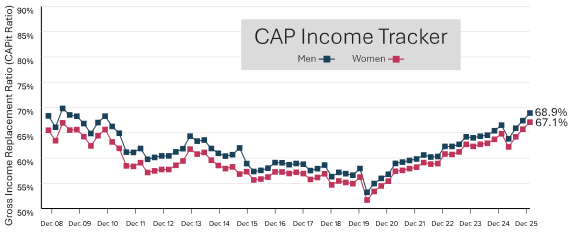
Because CAPit reflects broad market index performance in its projections, periods of strong market activity, such as the Q4 rally, translate directly into higher projected retirement outcomes. As such, this quarter’s improvement is largely a function of how robustly the indices performed to close out 2025.
While stronger markets improve projections for all members, the impact is not the same for everyone. This is where the sequence‑of‑returns effect becomes important. A strong return year when a member’s balance is at its highest, typically in the years leading up to retirement, can significantly shift the projected income replacement ratio. This is why two members with identical average returns over the same period can end up with very different retirement outcomes.
Another notable aspect of this quarter’s results is the contrast between index‑based projections and what some members may have experienced in actively managed portfolios. Because CAPit uses index returns, it fully captured the sectors and styles that drove the Q4 rally. Most active managers, however, were not positioned the same way. Some were underweighted in the top‑performing segments or leaned more defensively which caused them to lag the broader market. As a result, CAPit’s improvement this quarter may appear stronger than outcomes that might be realized by your members. This reflects the active‑versus‑passive dispersion we saw in Q4 and underscores CAPit’s role as a consistent, index‑based benchmark for understanding how broad market performance flows through to projected retirement income.
Overall, Q4’s strong index performance serves as a helpful reminder of how quickly retirement projections can shift and how differently those shifts are felt depending on where members are in their career. For those nearing retirement, market surges can meaningfully improve their projected income, while younger members benefit gradually as contributions and long‑term compounding do the heavy lifting. As we look ahead to 2026, continuing to provide clear projections, practical tools, and accessible education will help members understand these changes and stay confident in their ability to build a secure retirement.
About the CAP Income Tracker
The CAP Income Tracker assumes the member made annual contributions at a rate of 10% starting at age 40, will receive maximum Old Age Security and Canada/ Quebec Pension Plan payments, and will use their CAP account balance at retirement to buy an annuity. The member’s CAP account is invested based on a balanced strategy. Salary has been adjusted annually in line with changes in the average industrial wage, and is set at $77,624 as of December 31, 2025.
This issue of CAPit has been prepared for general information purposes only and does not constitute professional advice. Should you require professional advice based on the contents of this publication, please contact an Eckler consultant.